
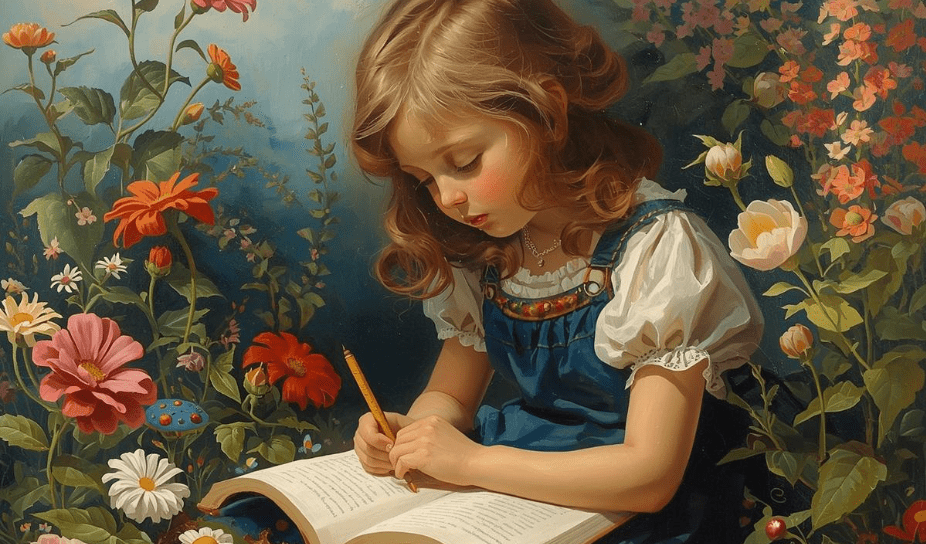
The World’s First Book Written by a Child
In this blog, we cover the legacy of Dorothy Straight — the world’s first child author — and how she redefined the public perception of reading.
How the World Began holds a very special place in literary history — it is recognized as the first published book written and illustrated by a child, the remarkable Dorothy Straight. She created it in 1962, at the age of just four, after her mother asked her a simple question: “Who made the world?” Rather than answering aloud, Dorothy picked up her crayons and began drawing and writing what would become a complete, heartfelt story. Two years later, in 1964, the book was published by Pantheon Books, making Dorothy the youngest person ever to have a book published commercially. Her work proved that a child’s imagination, unfiltered and sincere, can give birth to something timeless.
The story itself is a beautiful reflection of a child’s perspective on creation. In How the World Began, Dorothy describes how the world came into being — filled with love, playfulness, and the simple logic of a young mind trying to make sense of life’s biggest question. Her illustrations, made with bright, spontaneous strokes, capture the innocence and curiosity of childhood. The narrative doesn’t follow scientific or religious conventions but instead unfolds naturally, like a dream told in a child’s own words — free, colorful, and profound in its simplicity.
What makes the book extraordinary is not just its content, but what it represents. Dorothy Straight’s creation demonstrated to the world that creativity and wisdom are not limited by age. Her book blurred the lines between what adults believed children could do and what they were truly capable of. It invited educators, parents, and publishers to listen more deeply to children’s voices — to take their stories, ideas, and art seriously. It was a powerful reminder that imagination is not learned, but innate.
Over the years, How the World Began has become more than just a children’s story; it is a symbol of empowerment and creative freedom for young minds everywhere. It inspired generations of young authors to write fearlessly and reminded adults of the pure brilliance that lies in childhood curiosity. Today, it continues to be celebrated as a landmark in children’s literature — not merely for being “written by a child,” but for capturing what all great stories seek to express: wonder, innocence, and the endless possibility of imagination.
